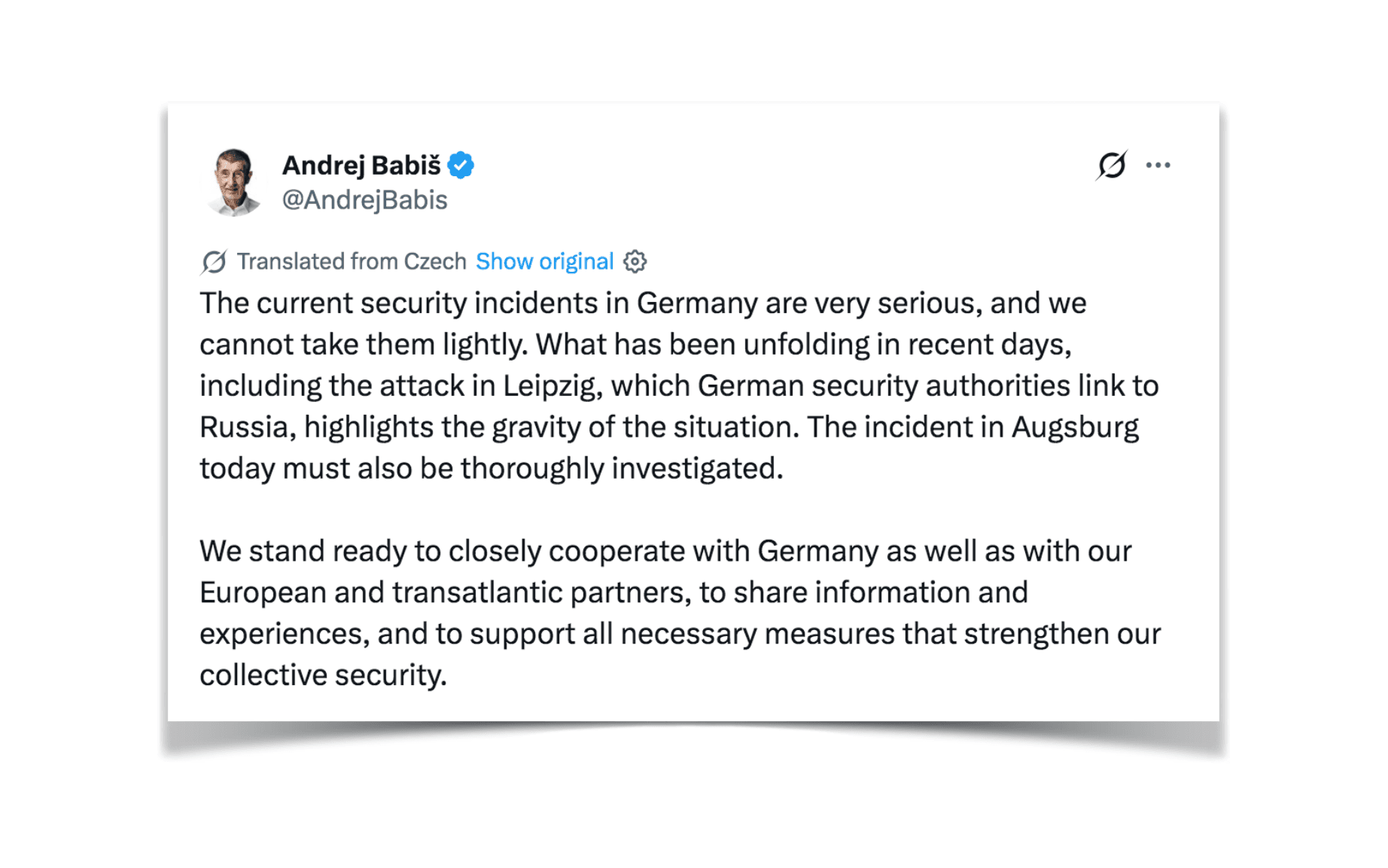
It's a strange way to support AfD if Russia is trying to blow up airplanes and is engaging in other acts of sabotage across Germany in the days and weeks before the state elections on Sun. in Saxony-Anhalt. Vladimir Putin must think that his "attempts to destabilize, spread disinformation, threaten, sabotage and show aggression towards Europe," as German Foreign Min. Johann Wadephul referred to it on Tues., will be seen as German provocation or false flags by a significant portion of AfD's potential voters and will in fact boost the party at the polls. German officials apparently don't see it this way, otherwise they wouldn't have timed their announcements and articles about AfD to coincide with the elections. Could spymaster Putin understand the mentality in his old playground (East Germany) better than the experts in Berlin? If so, Czech PM Andrej Babiš, Foreign Min. Petr Macinka and Pres. Petr Pavel are playing right into Putin's hands by supporting their German colleagues so vocally.
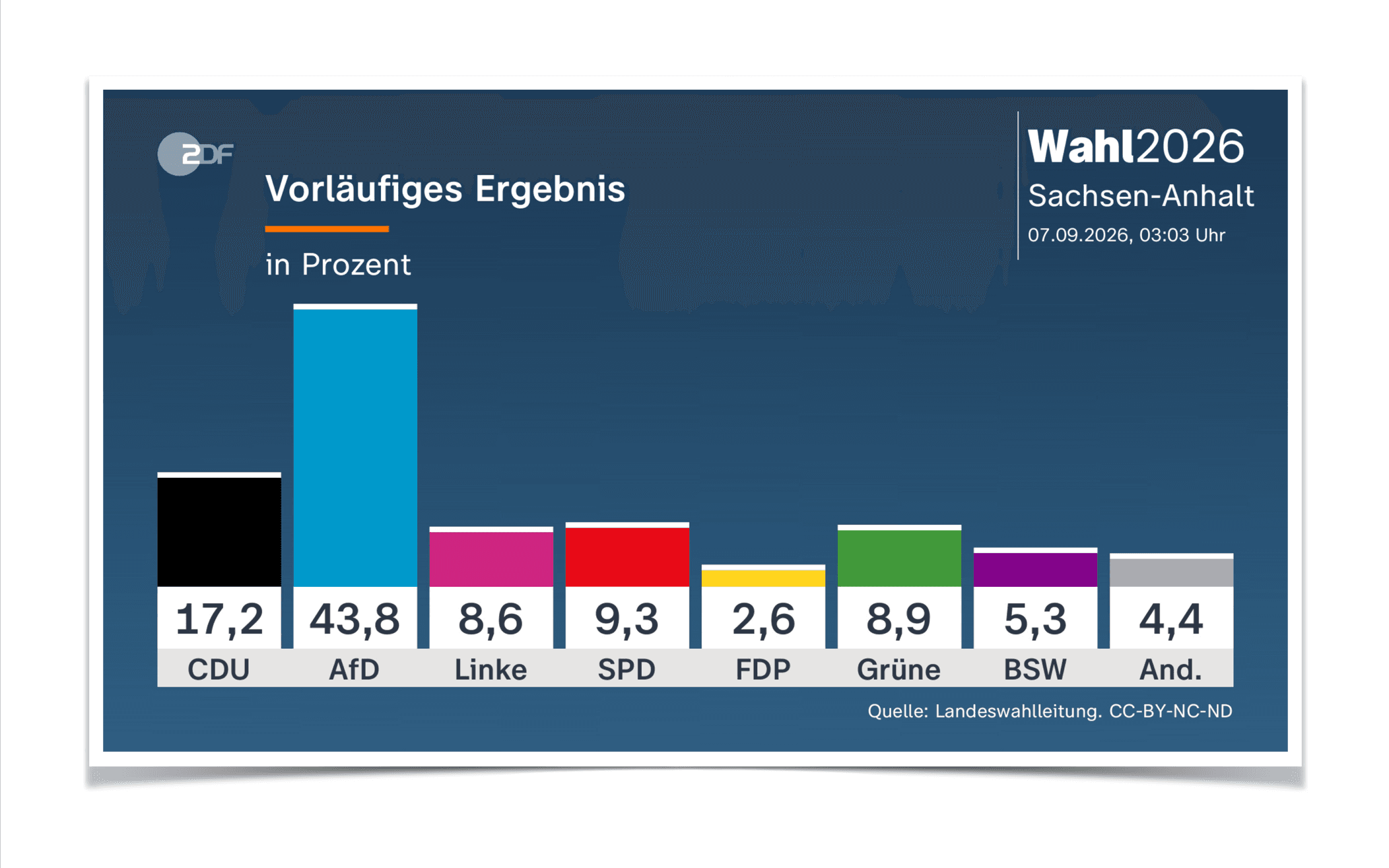
Yesterday's election results in Saxony-Anhalt are bad news for Czechs, regardless of whether they're fans or detractors of AfD. Such a lopsided victory by AfD against the two parties of the national coalition, CDU and SPD, shows the extent to which Germany is falling apart. How the mainstream parties now react to the intruders from AfD will have a tremendous impact on neighboring countries. Czech-German relations have gone through two main phases since 1989. There was initially a powerful, pervasive feeling that Germany represented the ultimate standard for economic success, institutional order and democracy. This started to change with Wir schaffen das, the Green Deal and deindustrialization, causing some Czech economists and businesspeople to warn against excessive dependence on German industry. The third phase is almost the complete antithesis of the first. The default assumption should now be that nothing good comes out of Germany. If this thesis is ever proven wrong, it will be a pleasant surprise.
German Chancellor Friedrich Merz said in Berlin yesterday that the election results in Saxony-Anhalt on Sun. will have domestic consequences as well as implications for the international situation. When nearly 60% of the voters opt for political parties that fundamentally cast doubt on our institutions and rules of the game, he said in reference to AfD, Die Linke and BSW, it's not something we can just brush aside. Czech PM Andrej Babiš said in Prague at about the same time that he doesn't think AfD's election victory means anything for the Czech Republic. He reduced it to an economic and EU-budget issue and said that what's important for us is how Germany votes on the European Council. ARD reported his words in the evening news a few hours later and said that Babiš knows Saxony-Anhalt very well as a businessman given that Agrofert has invested €1.6bn there. You could say that Babiš has 1.6bn reasons not to want any political turmoil in Saxony-Anhalt.
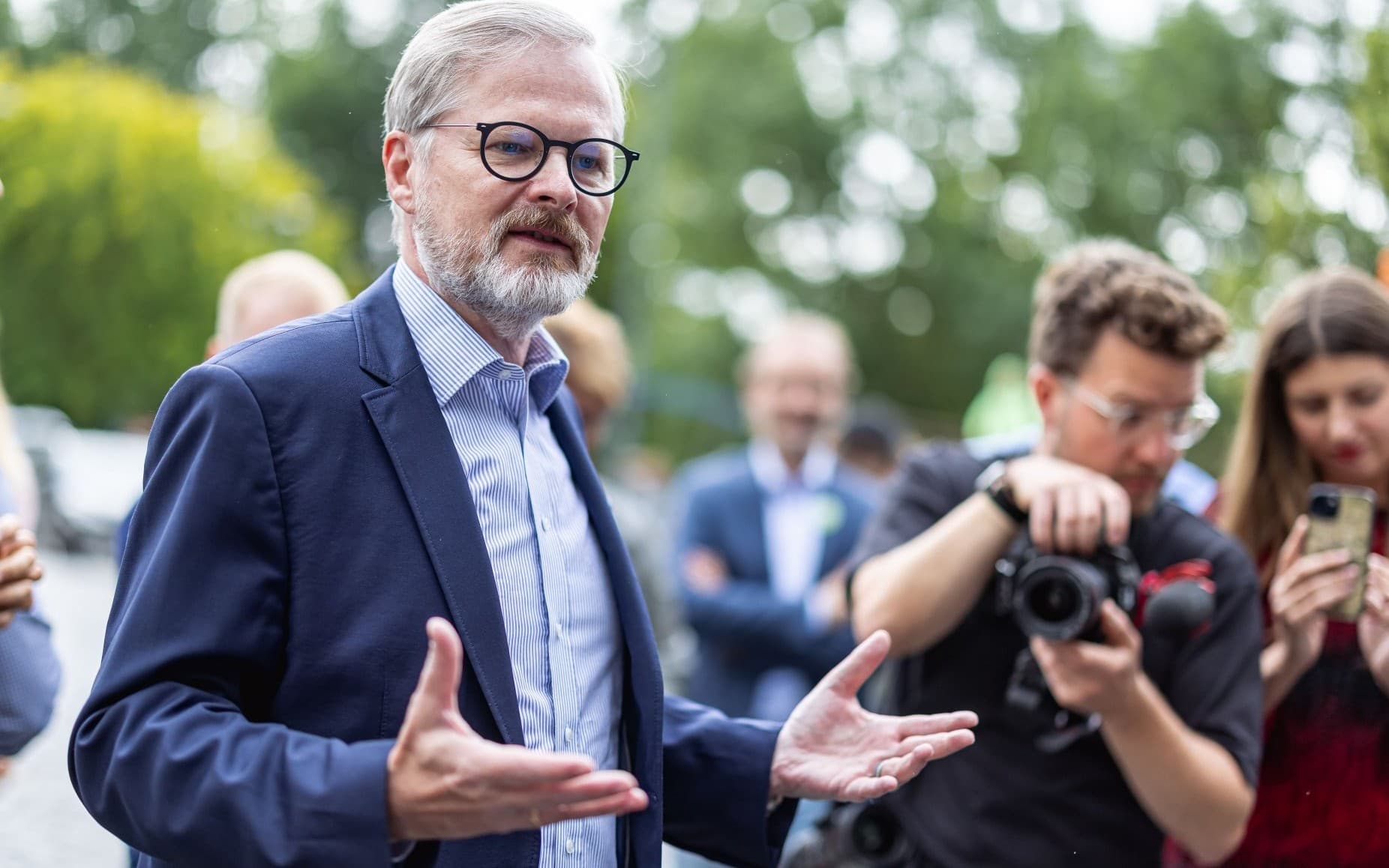
Prague probably won't be ODS's Saxony-Anhalt, but if the party does as poorly in the capital city in the elections in Oct. as indicated by a new Median poll, Martin Kupka and Tomáš Portlík will have some explaining to do. It would be a case of poetic justice if ex-PM Petr Fiala returned to run his party, given the way Kupka allegedly forced him out after the parliamentary elections. But it would also be ironic if the Czech version of Friedrich Merz had a comeback just as the real thing was being buried. It would show to what degree ODS had failed to understand what's happening in Western Europe. Fiala's tweets after the CDU disaster in Saxony-Anhalt boil down basically to a Merz-like call for "even more democracy," which sounds nice but actually means the opposite. ODS's only hope, with or without Fiala, is to take back the ground on the Right that it's losing to Moto and Our Czechia and to become the real correction to Andrej Babiš.